.png)
Blending Lines Made Simple: A Quick Routine for UFLI Small Groups
Every reading teacher should know how to use blending lines in their classroom—especially during UFLI small group instruction.

Blending lines (sometimes called fluency lines) are simple but incredibly powerful. They’re just a short list of words that follow the same phonics pattern, and students read them across the line for repeated decoding practice.
They fit perfectly into UFLI small group routines because they’re quick, targeted, and highly informative. In just 2–3 minutes, students get meaningful decoding practice while the teacher gathers valuable information about their reading skills.
Let’s walk through exactly how blending lines work, how to create them quickly, and how they can strengthen your UFLI small group instruction.
What Are Blending Lines in a UFLI Small Group?
Blending lines are targeted word lists that follow the same phonics pattern students are learning.
For example, if your UFLI small group is practicing the short a CVC pattern, your blending line might include words like:
map
mat
rag
cap
bat
Students read across the line, blending each word.
Because every word follows the same pattern, students get focused decoding practice tied directly to the phonics skill you're teaching.
Blending lines work beautifully in UFLI small groups because they allow you to:
reinforce the phonics pattern from the lesson
give students repeated decoding practice
quickly check for accuracy and automaticity
identify decoding errors in real time
If you'd like a simple blending line template you can use during your UFLI small group, you can grab a free one here → [Download the free blending line template].
Exactly How I Use Blending Lines During UFLI Small Groups
Here’s exactly what it sounds like when I use blending lines with a student in my UFLI small group.
I start by setting the purpose for the student: “These words follow the ___ pattern we’re practicing today.”
Then the student reads straight across the line, decoding each word.
If the student makes a mistake, I correct it immediately and have them reread the word correctly. Immediate feedback helps reinforce the correct phonics pattern and prevents students from practicing errors.
While the student reads, I’m also making quick mental or written notes about what I notice, such as:
confusion with vowel sounds
guessing instead of decoding
labored rate
This quick routine fits easily into UFLI small group instruction and only takes two minutes, but it gives me valuable information about how well students are applying the phonics skill.
How I Make Blending Lines for My UFLI Small Group in Under a Minute
You don’t need to spend lots of time preparing blending lines. In fact, you can create them in under a minute using the word lists already built into your phonics curriculum.
Here’s my simple process.
1. Find a word list from your curriculum
I often use the word lists from UFLI Foundations because they are already organized by phonics pattern, which makes them perfect for UFLI small group practice. But you can use a list from any phonics program.
2. Write 5–10 words that follow the same phonics pattern
Choose words that match the skill you're teaching during your UFLI small group lesson.
Keeping the words consistent helps students focus on one decoding pattern at a time.
3. Add nonsense words if you're using it for assessment
If I want to turn the blending line into a quick decoding check, I sometimes include a few nonsense words.
This helps determine whether students are truly decoding the phonics pattern.
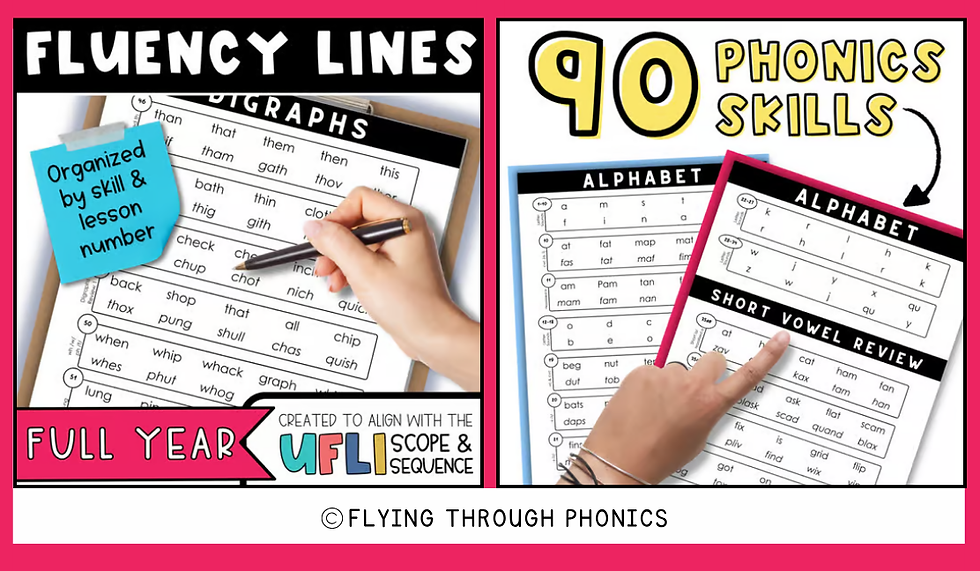
If you'd rather skip the prep work, you can also use ready-to-go blending lines organized for UFLI small groups here → [See the Fluency Lines resource].
Should You Use Nonsense Words in UFLI Small Groups?
You may have heard the advice: “Don’t have students practice reading nonsense words.”

There’s actually a good reason behind that.
Nonsense words like mup, rab, and jat are decodable, but they don’t carry meaning. Because the ultimate goal of reading is making meaning, nonsense words shouldn’t make up the majority of daily practice.
For most UFLI small group instruction, real decodable words are the better choice because they allow students to practice both decoding and comprehension.
However, nonsense words can still serve a helpful purpose.
Nonsense words are useful for assessment.
When you include a few nonsense words in a blending line, you can quickly see whether a student is:
truly decoding the phonics pattern, or
simply recognizing familiar words
If a student correctly reads a nonsense word like rab, it shows they are applying the phonics skill, not relying on memorized vocabulary.
For this reason, I occasionally include one or two nonsense words when using blending lines as a quick assessment during my UFLI small group instruction.
My Favorite Way to Organize Blending Lines for UFLI Small Groups
To make blending lines easy to use during instruction, I like to create a Fluency Lines Book for my small groups.
Here’s my system:
Print the blending lines
Place each page in page protectors
Bind them together into a small book
Now I have a ready-to-use resource for UFLI small groups that I can flip through quickly during instruction.
Students get consistent decoding practice, and I can easily revisit phonics patterns when needed.
Inside each student’s folder, I also keep a progress monitoring tracking sheet.
Here’s a quick tip that makes tracking simple: Use different colored pens for different dates. This allows you to see student progress over time at a glance.
If you want 90+ ready-to-use blending lines designed for small group phonics instruction, you can see the full resource here → [Get the Fluency Lines].
A Simple Tool That Strengthens Your UFLI Small Group Instruction
Blending lines may be simple, but they are one of the most effective tools you can add to your UFLI small group routine.
In just a few minutes, they allow you to:
provide targeted phonics practice
monitor student decoding accuracy
give immediate corrective feedback
track growth over time
If you’d like to start using blending lines in your UFLI small groups, you can grab the free blending line template here → [Download the free template].
Or if you'd prefer done-for-you fluency lines organized for phonics instruction, check out the full Fluency Lines Book here → [View the resource].


Comments