.png)
How to Use Elkonin Boxes (And the Mistake Almost Everyone Makes)
Hi, I'm Christan. Former classroom teacher, founder of Flying Through Phonics, and a little obsessed with making the Science of Reading easy for teachers and parents to actually use. Meet me →

A 6-year-old sat next to me last fall, stuck on the word "ship." She'd been guessing at it for weeks. We pulled out three little boxes and three small chips. I said the word slowly. /sh/.../i/.../p/. She pushed a chip into each box as she heard each sound. Then she looked up at me, eyes huge, and said, "Wait. Ship only has three sounds?"
That was the moment. That was the click.
If you've never used Elkonin boxes with a kid before, buckle up. They're one of the most powerful, low-prep, brain-friendly tools we have for teaching reading, and you can draw them in seconds.
What Are Elkonin Boxes?
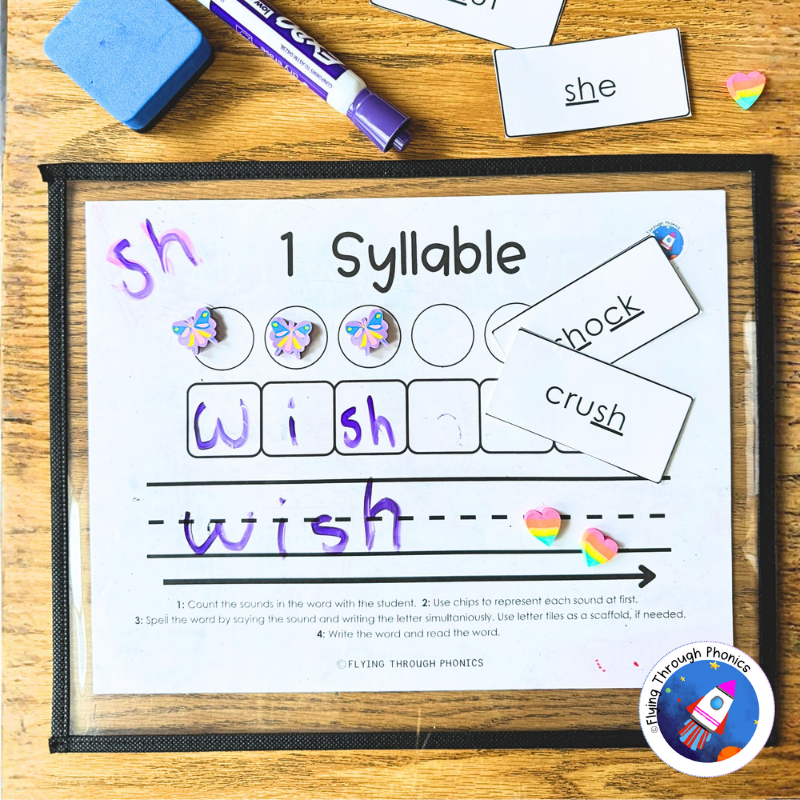
Elkonin boxes (also called sound boxes) are a row of small squares, one square for each sound in a word. Kids push a chip (or my favorite, mini erasers from the Target Dollar Spot!) into each box as they say each sound out loud. The boxes take an invisible thing, the sounds inside a word, and turn it into something a child can actually see and touch.
They were created by a Russian psychologist named D.B. Elkonin back in the 1960s, and decades of reading research have backed them up since. They're a core phonemic awareness tool, and phonemic awareness is one of the strongest predictors of reading success we have. 🧠
Sound boxes are your best friend when:
A child is struggling to hear the individual sounds inside a word
You're introducing a new digraph (sh, ch, th, ck) and you want them to feel it as one sound, not two
A reader keeps skipping or guessing at sounds in the middle of words
You need a quick, no-prep way to practice phonemic awareness on the carpet, in the car, or at the kitchen table
The Mistake Almost Everyone Makes
The number one mistake I see, from teachers AND parents, is putting one letter in each box instead of one sound.
"Wish" does not get four boxes. It gets three.
Box 1: /w/
Box 2: /i/
Box 3: /sh/
The "sh" is one sound, even though it's two letters. Same with "th," "ch," "ck," and "ng." One sound, one box.
My Sound Box Routine

Here's the simple flow I use with my own students, and the one I teach parents on day one:
Pick a short word. Start with 2 or 3-sound words like "at," "sun," or "ship."
Draw a box for each sound (not each letter).
Say the word slowly, stretching it out.
Have your child push one chip into each box as they say each sound.
Write the corresponding sounds in the boxes.
Blend it all back together and say the whole word.
That's it. No fancy tools needed. But there are a few ways to make it fun.
Pump up the fun
I like to switch out my Elkonin box pages to match the season. It’s even better if I have cute erasers to match!

Best place for seasonal chips: Mini Erasers from the Target Dollar Spot, Hobby Lobby in the seasonal section, small party favors from the dollar store, candy treats like M&Ms and Skittles
The Bottom Line
Elkonin boxes don’t have to be fancy. They're not flashy. They're just a row of little squares with some chips. But they're one of the closest things to a reading cheat code we've got, because they make the invisible visible, and that's exactly what a beginning reader's brain needs. ✨

Frequently Asked Questions About Elkonin Boxes
What are Elkonin boxes?
Elkonin boxes are a row of small squares used to teach children to break a word into its individual sounds. The child pushes a chip or token into one box for each sound they hear in a word, making invisible sounds something they can see and touch.
How do Elkonin boxes help kids learn to read?
Elkonin boxes build phonemic awareness, which is the ability to hear and manipulate individual sounds in spoken words. Phonemic awareness is one of the strongest predictors of early reading success, and once a child can hear the sounds, they can map them to letters and start decoding.
How many boxes should I draw for each word?
One box per sound, not per letter. The word "ship" gets three boxes (/sh/, /i/, /p/), not four, because "sh" is a single sound even though it uses two letters.
Can I use Elkonin boxes for digraphs like sh, ch, th, and ck?
Yes, and they're especially useful for digraphs. A digraph is two letters that make one sound, so it gets one box. For example, "chip" gets three boxes: /ch/, /i/, /p/.
Are Elkonin boxes part of the Science of Reading?
Yes. Elkonin boxes are a research-backed tool used in structured literacy and Science of Reading instruction. They directly target phonemic awareness, which is a foundational skill identified by the National Reading Panel as essential to learning to read.
What age are Elkonin boxes best for?
Elkonin boxes work best for children in pre-K through 2nd grade who are learning to hear individual sounds in words. They also help older struggling readers who missed phonemic awareness skills earlier and need to fill that gap.
What can my child use as chips for Elkonin boxes?
Anything small works. Pennies, buttons, dry beans, cereal pieces, mini erasers, pom-poms, or LEGO bricks are all great options. The object doesn't matter, the action of pushing one item per sound is what builds the skill.
When should I stop using Elkonin boxes?
Stop using Elkonin boxes when your child can confidently identify and blend the sounds in a word without needing the visual support. That usually happens after several weeks of consistent practice, and it's a sign their brain has internalized the work.
What's the difference between Elkonin boxes and sound boxes?
There is no difference. Elkonin boxes and sound boxes are two names for the same tool. "Sound boxes" is just the more common everyday name in American classrooms.


Comments