.png)
The Truth About the Summer Slide (And What Actually Stops It)
- May 27
- 5 min read
By Christan, founder of Flying Through Phonics • Elementary teacher/interventionist

Every August, I get the same message from teachers.
"My new firsties came in not remembering short vowels."
"My 2nd grader forgot every digraph she learned in May."
"My 3rd graders are reading like they're back in first grade."
The summer slide is real. It's not a parenting failure. It's not a teaching failure. It's just what happens when a growing brain takes 10-12 weeks off from a skill that needs consistent practice to stay sharp.
But here's what most people miss: summer slide isn't inevitable. And you don't need a curriculum, a tutor, or a five-day-a-week boot camp to stop it.
You just need the right kind of practice, done a few times a week, for about 15 minutes.
That's it.

Why Summer Reading Loss Actually Happens
Reading isn't just memorized. It's a brain pathway being built. Every time your child decodes (sounds out) a word, that pathway gets a little stronger. Take a 10-week break, and the pathway gets rusty. Not gone, but rusty.
For kids who were already behind, or who struggled all year, the slide is even steeper. The gap widens, and so does the catch-up work for both teachers and parents.
But for kids who keep practicing, even just a little, the slide basically disappears.

Why Random Summer Workbooks Don't Work
You can buy a "Summer Bridge" workbook at any big box store. They look colorful. They look reassuring. And for phonics review, they're mostly useless.
They aren't aligned to a real scope and sequence. They throw silent-e words next to short-a words next to multisyllabic words next to random sight word lists. There's no structure. The brain learns to read best in a specific, research-backed order, and most workbooks ignore that completely.
They aren't decodable. That means they include words your child hasn't been taught how to sound out yet. So your child guesses. Or skips. Or memorizes by shape. None of that builds a strong reading brain. It can actually hurt it.
If your child went through a structured phonics program like UFLI this year, the worst thing you can do is hand them a workbook that doesn't match.
What Actually Works
Three rules I give every parent and teacher who asks me what to do over summer:
Keep it short. 15 minutes, 3 or 4 times a week is plenty. Less is more when the practice is high quality.
Use decodable practice. Match what your child has already learned. A rising 2nd grader should review 1st grade skills, not random 4th grade vocabulary words.
Make it feel like a game. Fluency races, partner games, color the word, crack the code. If it feels like play, they'll actually do it. No tears, no battles.
That's the whole formula. Not complicated. But it has to be the right kind of practice.

Why I Built the Summer Slide Bundle
I got tired of telling parents and teachers "yes, the summer slide is real, no, that Amazon workbook isn't going to cut it" without giving them something better.
So I built it.
My Summer Slide Phonics Bundle is exactly what I wished was on the shelf at the bookstore. A print-and-go review packet for students finishing Kindergarten, 1st grade, and 2nd grade that follows UFLI's scope and sequence and uses 100% decodable words by UFLI lesson. Each packet has over 45+ pages of fun and meaningful summer practice.
It's the same skills your child or your students learned in their structured phonics block this year, reviewed through games and activities they actually want to do. Tic-Tac-Toe. Honeycomb partner game. Fluency races. Read and color ocean animals. Dots & Boxes. Crack the Code. Real review dressed up as play.
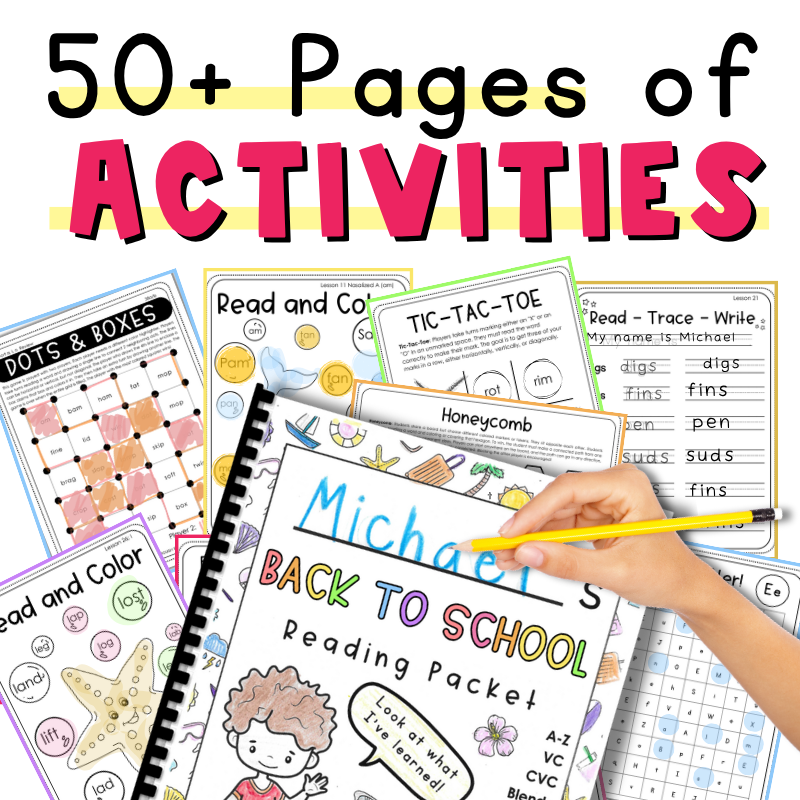
Skills covered span everything from A-Z and CVC words all the way through blends, digraphs, VCe, suffixes and prefixes, r-controlled vowels, long vowel teams, diphthongs, silent letters, and multisyllabic words. Whatever your kid worked on this year, it's in here.
Teachers, you can use it as a beginning-of-year review packet in August or as an early-finisher activity for these last weeks of school. Two of the four cover options are grade-neutral on purpose, which makes the packets work beautifully for intervention groups too.
Parents, you can send it home with confidence that you're not undoing what your child's teacher worked all year to build.
No prep. No printing surprises. Just print and go.
Frequently Asked Questions About the Summer Slide
What is the summer slide?
The summer slide is the loss of academic skills that happens when children take an extended break from learning over summer vacation. In reading, K-2 students can lose up to two months of progress over a single summer if they don't practice.
How much should my child read over summer to prevent the slide?
About 15 minutes of structured phonics practice, 3 to 4 times a week, is enough to prevent most summer reading loss in K-2 students. Quality matters more than quantity.
Do summer workbooks from the store actually work?
Most generic summer workbooks do not follow a research-based phonics scope and sequence and include words your child has not been taught to decode yet. They can feel productive but often do little to prevent reading regression.
What does "decodable" mean?
Decodable text uses only the letter-sound patterns and high-frequency words a child has already been taught. This lets them practice sounding out words rather than guessing, which builds the brain pathways needed for fluent reading.
Are the Flying Through Phonics summer packets aligned to UFLI?
Yes. The resource follows UFLI's scope and sequence exactly and uses 100% decodable words by UFLI lesson, so it works perfectly as review for any student in a UFLI classroom.
Can the Summer Slide Bundle be used for intervention groups?
Yes. Two cover options don’t mention the grade level at all, making the packets a great fit for intervention and small group practice with students at various levels.
The Bottom Line
The summer slide is real, but it's not a fate you have to accept. Fifteen minutes, three or four times a week, with practice that's actually aligned to what your child learned this year, is enough to keep their reading brain sharp and their September self confident.
The Amazon workbook isn't going to do it. But the right tool, the right scope, and a few minutes a day will.
You've got this. ☀️

Christan is a former [grade] classroom teacher and the founder of Flying Through Phonics. She creates UFLI-aligned, Science of Reading-backed phonics resources used by [thousands of] teachers and homeschool families across the country. Read more about Christan →


Comments